PRC - District Partnership
PRC-District Partnership
Overview
The District supports conservation efforts and research pursued by the Westchester County Department Parks, Recreation, and Conservation (PRC). The District works with PRC to identify key reports and deliverables that can be provided to the District and become a resource for municipalities and the public. Given the District does not have its own conservation technicians or field staff, the relationship with PRC is instrumental in implementing conservation practices and facilitating scientific research throughout the Westchester County.
Chronolog
A Chronolog is a public science project that invites anyone to participate in environmental monitoring using only a smartphone. Each Chronolog station includes a fixed photo bracket and a QR code for easy uploads. The District supports its County Conservation Parks through six Chronolog stations.
Notable District-Parks, Recreation and Conservation Projects
Grassland Restoration Project at Croton Point Park
The County of Westchester 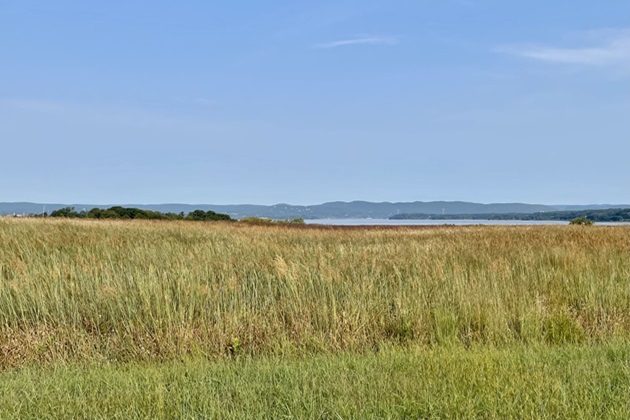 completed restoration of the largest grassland habitat in the Hudson River corridor. The grassland sits atop the former landfill at Croton Point Park. The project was paid for with state funding to the Soil and Water Conservation District. More than 85 acres of grassland has been restored under the three-year-long project. The grassland provides a critically important place for ground-nesting and migratory birds, including songbirds and raptors, to find shelter, build a home, feed and rest throughout the year. Restoration is expected to halt the grassland’s steady decline in habitat value and raise it to its full ecological capabilities by removing less desirable, invasive plants in favor of more ecologically friendly native plants.
Edith G. Read Living Shoreline
Edith G. Read Wildlife Sanctuary is located on Long Island Sound and has been subject to deca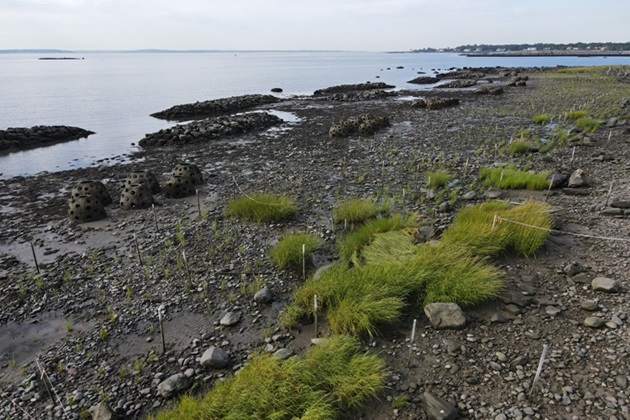 des of severe storms caused erosion and flooding issues along with habitat loss to Westchester County (the “County”) property. In 2024, the County began construction of a natural and nature-based shoreline to improve storm resiliency and provide additional habitat for migratory, marine and terrestrial species, also referred to as a living shoreline. The restoration areas are divided up into two (2) sections that include 4.68 acres of upland dune area, and 4.32 acres of intertidal marsh. For purposes of defining terms, the ‘intertidal marsh’ referenced here is called the Coastal Erosion Hazard Area (CEHA) in the Monitoring Plan. NYSDEC required adherence to Natural Resource Permit Conditions that include long-term plant survival and the submission of annual maintenance and monitoring reports (the “Monitoring Plan”). NYSDEC requires the Natural Resource Permit Conditions be followed for five (5) years post-construction. The County, through its consultant, submitted and received approval for a monitoring plan.
Lasdon Public Gardens: Hemlock and Beech leaf disease projects
Lasdon has a stand of approximately 100 hemlocks with an estimated average diameter at breast height of 20 inches that grow on a steep embankment in the Muscoot River drainage basin. This stand like many others in the region are infected with Hemlock Wooly Adelgid and Elongated Hemlock Scale. The loss of hemlocks on steep slopes in river basins has tremendous impact on water quality and soil erosion. Local partners including the Mianus River Gorge Preserve, New York State Parks and New York City Department of Environmental Protection (DEP) are all actively managing Hemlock Wooly Adelgid and Elongated Hemlock Scale to save hemlock stands, the biodiversity they support being a foundation species, and preserve drinking water. Hemlocks are key players in keeping drinking water cool and clean. Their shallow, branching root systems help filter runoff and keep water clean along stream corridors. Hemlocks make up much of the forest along shorelines and streams, and are critical for preventing sedimentation and filtering out pollutants (Cornell University, NYS Hemlock Initiative, 2024).
This project establishes a partnership between Westchester County Department of Parks, Recreation and Conservation (PRC), Soil and Water Conservation District, Department of Planning and DEP's Natural Resource Section. The partnership allows PRC to perform hemlock treatments on City-owned land. Work is an extension of that taking place on Westchester County land, which by way of connectivity, would require associated treatments for the success of the effort. PRC staff will perform the applications. Similarly, PRC and DEP would work together to install and monitor fencing related to beech leaf disease.
Hemlocks are key players in keeping drinking water cool and clean. Their shallow, branching root systems help filter runoff and keep water clean along stream corridors. Hemlocks make up much of the forest along shorelines and streams, and are critical for preventing sedimentation and filtering out pollutants (Cornell University, NYS Hemlock Initiative, 2024). Many of these hemlocks are located on steep slopes and their preservation is key in the reduction of run off and slope destabilization.
Vernal Pool Research
The purpose of this project is to monitor vernal pools to assess the impact of climate change on pool dry-up dates, assess the biological productivity of pools, and determine the impact of nutrient runoff into pools. Vernal pools are a unique and important habitat type for amphibian reproduction. Therefore, healthy vernal pools are important for maintaining amphibian biodiversity. Additionally, vernal pools help protect soil and water quality by providing flood control because they collect water. This helps prevent soil erosion and helps recharge groundways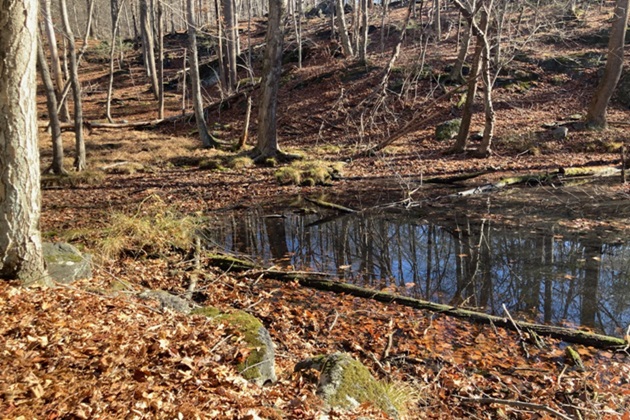 ter.
In 2024, staff attended an algae workshop to assess changes in algal growth in pools that may be correlated to nutrient loading, possibly caused by jumping worm castings. Remote detection equipment capable of logging water depth and temperature was purchased and candidate pools identified. Pools were dry when equipment was received so installation will occur after recharge. YSI probes and acoustic monitoring devices for frogs were also purchased.
In 2025, ten pools were intensively monitored throughout the entirety of the active season. This will include continuous logging of pool depth and temperature, recording of frog calls via acoustic monitoring, regular water quality testing for nitrates, phosphates, dissolved oxygen, pH, and conductivity, egg mass counts and identification, and assessment of the habitat conditions in the vernal pool buffer zone. Training was also provided for community volunteers who can perform observational monitoring on pools not included in the formal study. The procedure is currently being updated with methods for counting egg mass density and for analyzing buffer zone conditions.